
Every sales team has the same hidden tax: time spent on leads that were never going to buy. A rep can only call so many people in a day, and when leads are worked in the order they arrived — or worse, in the order that shouts loudest — the deals that would have closed quietly go cold. AI lead scoring fixes the order of operations.
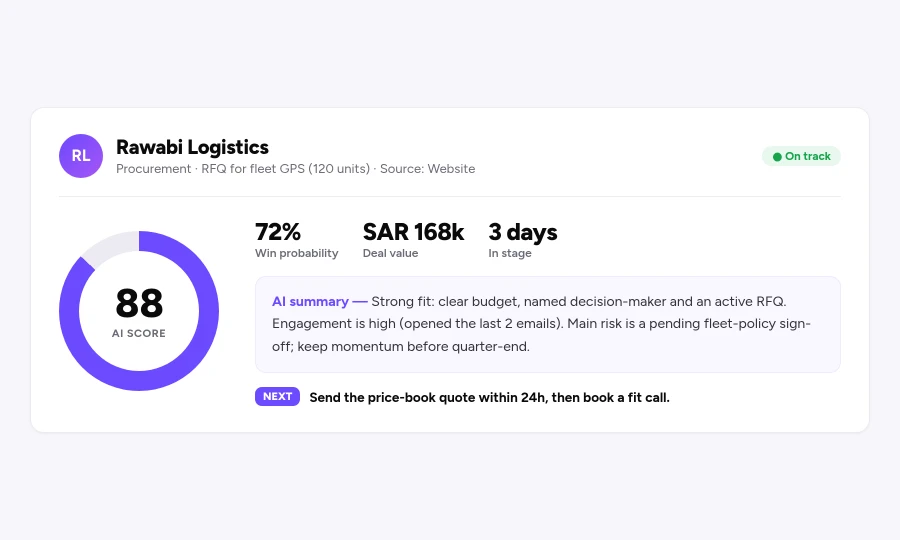
In Skyline Sales OS, the moment a lead lands it is read by AI and given three things: a score, a win-probability, and a short summary. Together they answer the only question that matters first thing in the morning — who do I call before lunch?
What the AI score actually measures
The score is a single, comparable number that ranks a lead against the others in your pipeline. It is produced by leading large language models reading the signal you already capture: the source the lead came from, what they asked for, the size and shape of the opportunity, and how engaged they have been. A walk-in enquiry for a single licence and a referred request for a fifty-seat rollout do not deserve the same slot in your day, and the score makes that difference visible at a glance instead of buried in your memory.
Because the score is comparable across the whole board, it is also a triage tool for a manager. You can see whether this week's inbound is genuinely strong or just noisy, and whether a rep is sitting on high-scoring leads they have not yet actioned.
Win-probability: the honest number
A score tells you relative priority; the win-probability tells you the likelihood this specific deal closes. It is expressed as a percentage you can reason about, and it is the same number that powers your weighted forecast, so sales and finance are never arguing about two different optimisms. When a deal advances, stalls, or a quote is accepted, the probability moves with it.
This matters for Saudi teams running long, relationship-led B2B cycles. A deal can look busy — lots of meetings, lots of WhatsApp — while its real probability barely moves. Putting an honest percentage on the card stops a team from mistaking activity for progress.
The AI summary: context in one breath
Next to the score sits a short, AI-written summary of the lead — who they appear to be, what they want, and why they matter. It means a rep picking up a handed-over lead, or a manager scanning the board, gets the gist without reading a thread of forty messages. New team members ramp faster, and nobody walks into a call cold.
Auto-assign: the right rep, automatically
A great score is wasted if the lead waits two days for someone to claim it. Skyline Sales OS can auto-assign each new lead to the best-fit rep, balancing two things: current workload, so nobody is buried, and recent wins, so hot leads go to whoever is converting right now. If those signals are even, it falls back to round-robin, so distribution stays fair. The result is that leads are worked in minutes, not on Monday.
You stay in control: auto-assign is a setting, not a mandate, and you can route by territory or product where that fits your team better. See how it pairs with no-code automations for routing you design yourself.
Deal health: a read on what is already in play
Scoring is not only for new leads. For deals already moving through the pipeline, an AI deal-health read labels each one on-track, at-risk, or stalled, and suggests a next action. A deal that has not moved a stage in weeks, or whose probability is sliding, gets surfaced before it quietly dies — and the suggested action gives a busy rep a concrete thing to do rather than a vague "follow up".
| Signal | What it answers | Where it appears |
|---|---|---|
| AI score | Which lead first? | Lead card |
| Win-probability | How likely to close? | Lead/deal card + forecast |
| AI summary | Who is this, in one line? | Lead card |
| Auto-assign | Who should own it? | On lead creation |
| Deal health | Is this deal slipping? | Deal card |
How this changes a Saudi sales week
Picture a distributor in Riyadh receiving sixty leads a week across WhatsApp, web forms and lead ads. Without scoring, the team works whatever is on top, and the fifty-seat opportunity that came in on Tuesday sits behind a dozen tyre-kickers. With Skyline Sales OS, that opportunity is scored high, given a real win-probability, summarised in a line, and auto-assigned to the rep who closed two similar deals last month — all before anyone has had their first coffee. The win-rate does not improve because the team works harder; it improves because they work the right deals in the right order.
Frequently asked questions
Does the AI replace my reps' judgement?
No. The score, probability and summary are decision support. Your team still owns the relationship and the call — the AI just makes sure they spend their hours where the revenue is.
What powers the scoring?
Leading large language models, reading the lead data already captured in Skyline Sales OS. No separate data-science project is required of you.
Can I override an auto-assignment?
Yes. Assignment is a drag away on the pipeline board, and you can switch auto-assign off or route by your own rules at any time.
Is my lead data sent outside the Kingdom?
Skyline Sales OS is hosted in-Kingdom on Skyline Cloud and built with PDPL and data-residency in mind. See CRM for Saudi Arabia.
Put a real lead through it
The clearest test is your own pipeline. Bring a handful of recent leads and watch how Skyline Sales OS scores, summarises and routes them. To arrange a tailored session and pricing, request a Skyline Sales OS demo.
Comments
0 total · 0 threads