

"AI agent" has become a crowded phrase. To a vendor it can mean anything from a glorified FAQ bot to a system that books flights. So let us be precise: an agent is software that, given a goal, plans a sequence of steps, uses tools to carry them out, checks its own progress, and stops to ask a human when it hits a boundary you defined. The difference from a chatbot is action. A chatbot answers; an agent does.
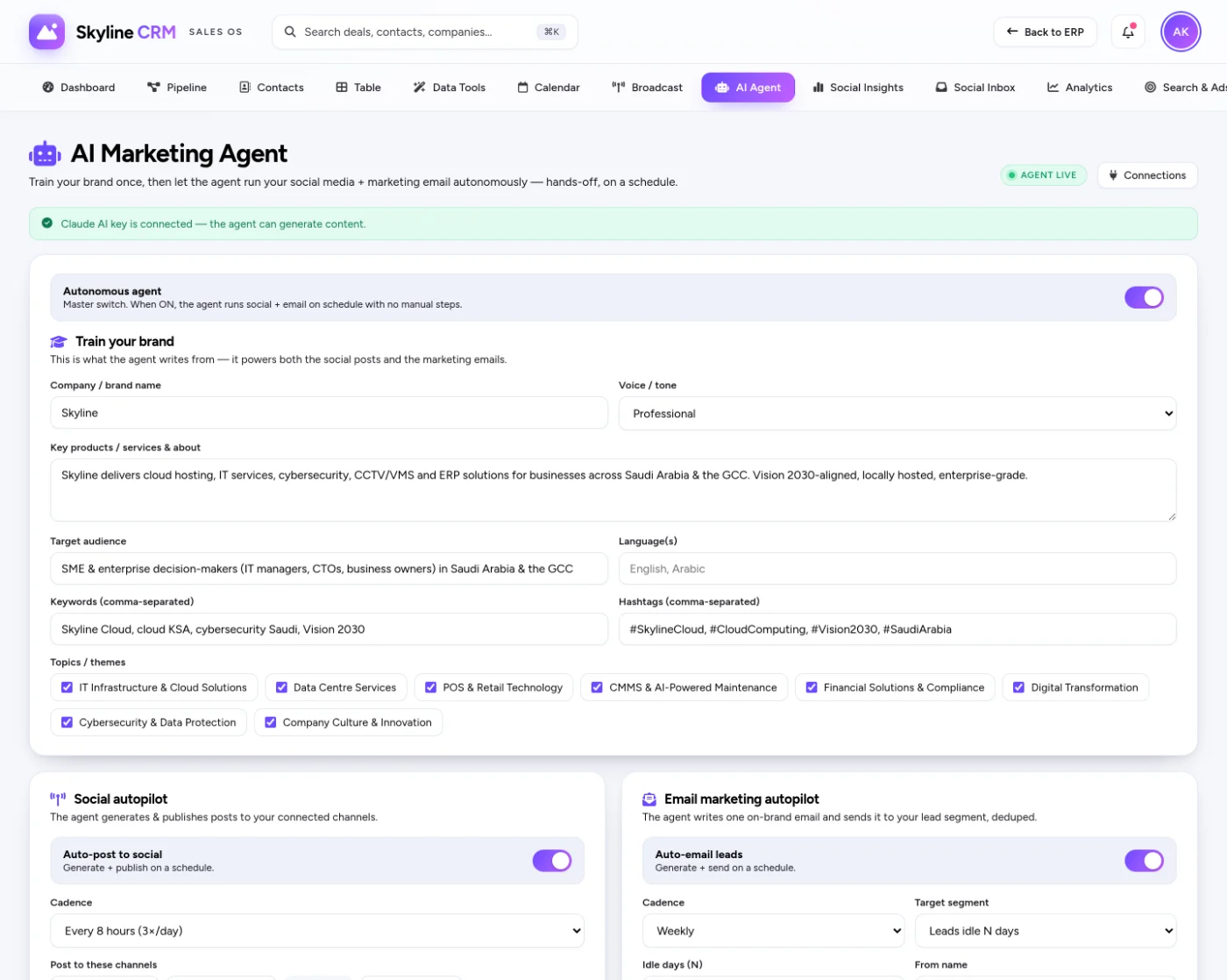
The four parts of a real agent
Every agent worth deploying has the same anatomy:
- A goal and a model. A leading large language model provides reasoning; you provide the objective and the constraints.
- Tools. The agent can call your systems — search a database, create a quote, send a draft email, open a ticket — through controlled connectors. Without tools an agent is just a chatbot.
- Memory and context. It remembers the conversation, the customer record, and the relevant policy so it does not start cold each turn.
- Guardrails. Hard limits on what it may do unsupervised, and the points where it must hand back to a person.
If a vendor cannot show you these four, you are looking at a chatbot with marketing.
Where agents pay off in Saudi businesses
Agents earn their keep on work that is repetitive but not trivial — tasks with several steps, some judgement, and a clear definition of done.
- Sales triage. An agent reads an inbound enquiry, enriches it, scores intent, drafts a first reply in Arabic or English, and routes it to the right rep. This is live today inside Skyline Sales OS — read the Sales OS AI CRM story.
- IT and customer support. An agent reads a ticket, searches your knowledge base, and drafts a grounded answer for an agent to approve — exactly how Skyline's own IT-support assistant works.
- Back-office email. Agents that read inbound business mail — RFQs, vendor questions, onboarding requests — and draft structured replies, escalating anything unusual. Skyline runs these desks on its own operation.
- Procurement and quoting. An agent gathers requirements, checks a price book, assembles a draft quote, and flags exceptions for a buyer.
In each case the agent compresses hours of routine handling into seconds, while a human keeps the final say.
The honesty line: agents augment, they do not replace
A capable agent will handle the bulk of routine cases, freeing your team for the ones that genuinely need a human. That is the real prize — not headcount cuts, but capacity. We are deliberate about this: an agent that touches money, contracts, or a customer relationship proposes; it does not commit without approval. Generative reasoning can be confidently wrong, so consequential steps always carry a review gate. The same discipline appears in our honest guide to generative AI.
Building one safely
A safe agent deployment follows a pattern:
- Scope the goal narrowly. "Draft replies to warranty questions," not "handle support."
- Whitelist the tools. Give it exactly the connectors it needs and nothing more.
- Set the autonomy level. Start in draft-only mode — the agent proposes, a human sends. Widen autonomy only where the cost of error is low and the track record is proven.
- Log everything. Every action, every tool call, every approval, for audit and improvement.
- Keep data in bounds. For Saudi organisations, the agent and its memory should respect your residency rules — see AI, PDPL and data residency.
Most agents pair naturally with broader automation; if you are mapping end-to-end processes, read the AI workflow automation guide next, and the pillar on integrating AI into your software for the big picture.
Build vs buy for agents
Generic agents (a calendar assistant, a meeting summariser) are cheap to buy. The agents that move the needle are tied to your data, your tools, and your Arabic content — and those are usually a custom build wired to leading large language models through APIs. We help you decide which is which.
Frequently asked questions
What is the difference between an AI agent and a chatbot?
A chatbot answers questions; an agent plans and carries out multi-step work using your tools, then stops at the boundaries you set. The difference is action.
Will an agent take actions without my approval?
Only where you explicitly allow it. Anything consequential — money, contracts, customers — stays in draft-only or approval mode until you have proven the track record.
Can an agent work in Arabic?
Yes. Agents we build understand and respond in Saudi Arabic and English, including mixed-language messages.
How do I start safely?
Pick one high-volume, multi-step task and run a single agent in draft-only mode. You see exactly how it reasons before widening its autonomy.
How do you stop an agent going off the rails?
With hard guardrails: a whitelist of exactly the tools it may use, a defined autonomy level, and a full log of every action and tool call for audit. It only widens its scope once it has earned it.
Start with one agent
Pick one high-volume, multi-step task and let us build a single agent that does it well in draft-only mode. You will see exactly how it reasons, what it touches, and where the human stays in control. Book a free AI consultation to scope it, or explore the Skyline AI Integration service to see the building blocks.
Comments
0 total · 0 threads