
Sooner or later every AI initiative reaches the same fork: subscribe to a ready-made tool, or build something custom on top of leading large language models. There is no universally right answer — only a right answer for a specific job. This is the framework we use with clients, with the tradeoffs stated honestly rather than sold.
The three options, plainly
Most people frame this as two choices, but there are really three:
- Buy — a finished SaaS product with AI inside (an AI writing tool, a generic support bot, an analytics add-on). Fast, cheap to start, low control.
- Build — a custom application or feature your team (or a partner) develops on top of model APIs, tailored to your data and workflow. Slower, higher control, your differentiator.
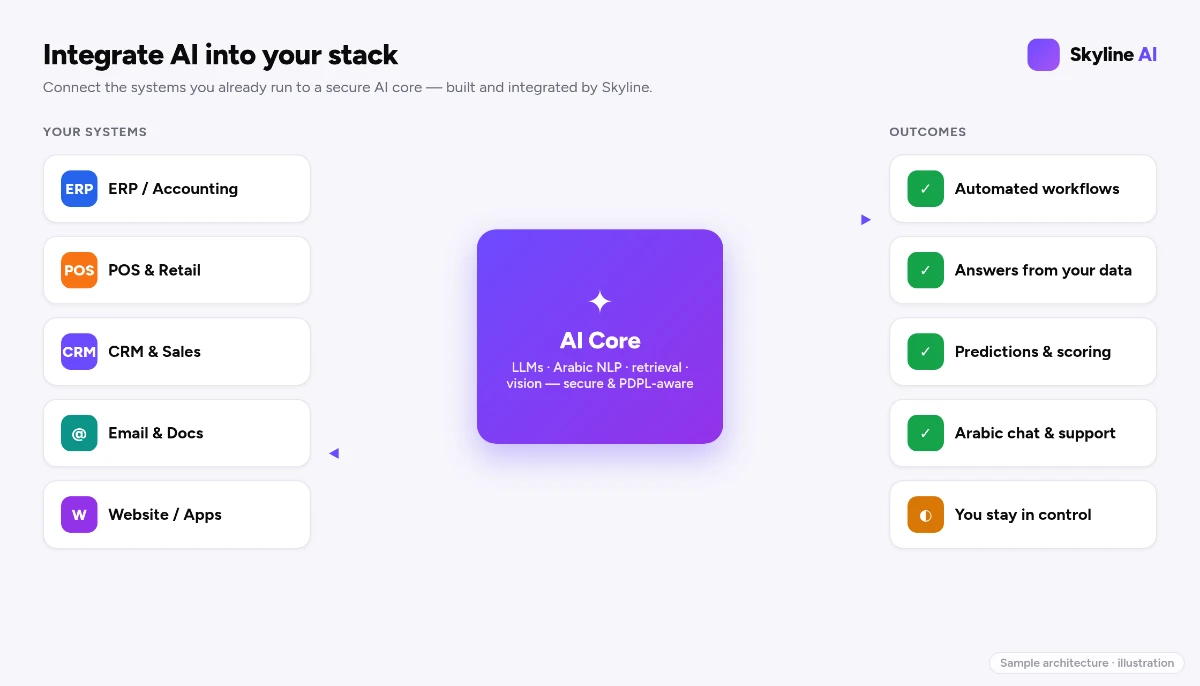
- Wire — the middle path: integrate model APIs into the software you already run, adding AI where it matters without rebuilding everything. Often the highest return.
The art is matching the option to the task.
When buying is the right call
Buy when the task is generic and not core to your advantage. Drafting marketing copy, transcribing meetings, summarising documents, generic grammar help — these are commodities. A subscription gets you 80% of the value tomorrow for a predictable fee, and there is no point building what the market already sells cheaply. Buy the commodity.
The catch: read where the vendor processes your data and what it retains. For Saudi organisations, a tool that ships customer data abroad may be a poor fit regardless of price — see AI, PDPL and data residency.
When building wins
Build when the AI touches your differentiator — the workflow, data, or customer experience that makes you you. Three signals point to build:
- Your Arabic, your domain. Off-the-shelf tools rarely handle Saudi dialect, your terminology, or your industry's nuance well. If language quality is the product, generic will disappoint — see building an Arabic AI chatbot.
- Your data is the moat. If the value comes from answering over your documents or acting inside your systems, you need a RAG assistant or a custom agent, not a generic tool.
- Residency and control matter. When regulated data cannot leave the Kingdom, a build you host gives you control a SaaS subscription cannot.
The honest cost picture
Buying looks cheaper because the cost is visible — a monthly fee. Building has a higher upfront cost but a different long-run curve: you own the asset, avoid per-seat creep across a large team, and are not exposed to a vendor changing terms. Neither is "cheaper" in the abstract; it depends on scale, lifespan and how core the capability is. We will not quote a generic price here — real numbers come from a scoped conversation, not a guess, which is why pricing is always a free consultation and tailored quote.
A hidden cost of building, stated plainly: AI features need ongoing care — monitoring, evaluation, updates as models improve. Budget for the operate phase, not just the build.
The pragmatic default: wire, don't replace
For most established Saudi businesses, the highest-return move is neither pure buy nor a ground-up build — it is wiring leading large language models into the systems you already run via APIs. Add a grounded assistant to your help desk, an AI layer to your CRM, document AI to your finance flow. You keep your proven systems and gain intelligence exactly where it pays. This is the heart of the pillar guide to integrating AI into your business software, and it is how AI lands inside ERP, POS and CRM systems.
A simple decision test
Ask three questions about the task:
- Is it generic or core? Generic leans buy; core leans build.
- Does it depend on your data or Arabic? If yes, lean build or wire.
- Can the data leave the Kingdom? If no, lean build/wire on infrastructure you control.
Two "build/wire" answers usually settle it.
Frequently asked questions
Is building always better than buying?
No. Buy commodity capabilities, build the parts that differentiate you, and wire leading large language models into the systems you already run. The right answer is per-task.
How much does a custom AI build cost?
It depends entirely on scope, scale and how core the capability is. We do not quote generic numbers — pricing comes as a tailored quote after a free consultation.
Can I start small instead of committing to a big build?
Yes. The lowest-risk move is usually to wire one model-powered use case into an existing system and expand from proven results.
What if my data cannot leave Saudi Arabia?
That pushes you toward a build or integration you host, which gives control a generic SaaS subscription cannot.
What ongoing costs should I plan for?
AI features need care after launch — monitoring, evaluation and updates as models improve. Budget for the operate phase, not just the initial build, so the system stays accurate over time.
Decide with people who have done both
Skyline both builds custom AI and integrates models into existing systems — and we will tell you honestly when buying off the shelf is the smarter move. Book a free AI consultation and we will run your specific task through this framework, or explore the Skyline AI Integration service to see what a build looks like.
Comments
0 total · 0 threads