
Arabic is the language of your customers, but it is the hard mode of conversational AI. Diacritics are usually dropped, dialects vary from Najdi to Hijazi to Khaleeji, people mix Arabic and English in a single sentence ("خلصت الـ order ولا؟"), and the script runs right to left. A chatbot that was built for English and then "translated" will feel foreign to a Saudi user within two messages. Building one that feels native is a deliberate craft.
Why most Arabic bots disappoint
The common failures are predictable. The bot understands formal Modern Standard Arabic but stalls on dialect. It answers in stiff, translated phrasing that no Saudi would actually say. The interface mirrors awkwardly in right-to-left, breaking buttons and numbers. And it hallucinates policies your business never had. None of these are unsolvable — they are simply skipped when Arabic is an afterthought.
What "done right" actually requires
Dialect and code-switching. Leading large language models now handle Gulf Arabic and Arabic-English mixing far better than rule-based systems ever did, but they still need prompting, examples, and testing against real Saudi messages — not textbook Arabic. We test on the messy way people genuinely write.
A native voice, not a translation. The bot's replies should be written in natural Saudi register — warm, direct, and culturally aware (greetings, the right level of formality, sensitivity around timing in Ramadan and prayer times). This is rewriting, not machine translation.
Right-to-left done properly. Numbers, dates, embedded English terms and interactive buttons all need correct bidirectional handling so the experience looks designed, not bolted on.
Grounding in your content. A chatbot should answer from your real policies, catalogue and FAQs — not improvise. The cleanest way to achieve this is retrieval: connect the bot to your documents so every answer is sourced. That technique deserves its own read — see the RAG knowledge assistant explained.
Meet customers on WhatsApp
In Saudi Arabia the conversation usually happens on WhatsApp, not a website widget. An Arabic assistant that lives where your customers already are — answering enquiries, sharing catalogue items, qualifying leads, and handing hot ones to sales — will out-convert any buried web form. The same assistant can sit on your site, app and Instagram too, with one shared brain.
Always leave a door to a human
The fastest way to lose trust is a bot that traps a customer in a loop. A well-built Arabic assistant knows the limits of its knowledge and escalates gracefully: when confidence is low, when emotion is high, or when the request touches money or a complaint, it hands over to a person with the full conversation attached. The goal is deflection of the routine, not denial of the human.
Keep it grounded and honest
Because generative models can produce fluent nonsense, an Arabic bot must be constrained to your facts and told to say "I am not sure, let me connect you to a colleague" rather than invent. We design these guardrails in from the start; the broader discipline is covered in our honest guide to generative AI. For deeper, action-taking conversations, the bot can graduate into a full custom AI agent.
Residency and privacy
Customer conversations are personal data. For Saudi organisations the chat logs, the customer details inside them, and where the model processes them all fall under PDPL. We deploy Arabic assistants with residency in mind — on Skyline Cloud or your own environment — and minimise what leaves the Kingdom. The detail lives in AI, PDPL and data residency.
A realistic build path
- Collect real conversations. Export a few hundred genuine Arabic enquiries — these define what "good" means.
- Ground the bot. Connect it to your FAQs, catalogue and policies.
- Tune the voice. Iterate the Saudi register until colleagues say "yes, that sounds like us."
- Set escalation rules. Define exactly when a human takes over.
- Pilot on one channel. Usually WhatsApp. Measure deflection, satisfaction and conversion.
- Expand. Add channels and languages once the core is proven.
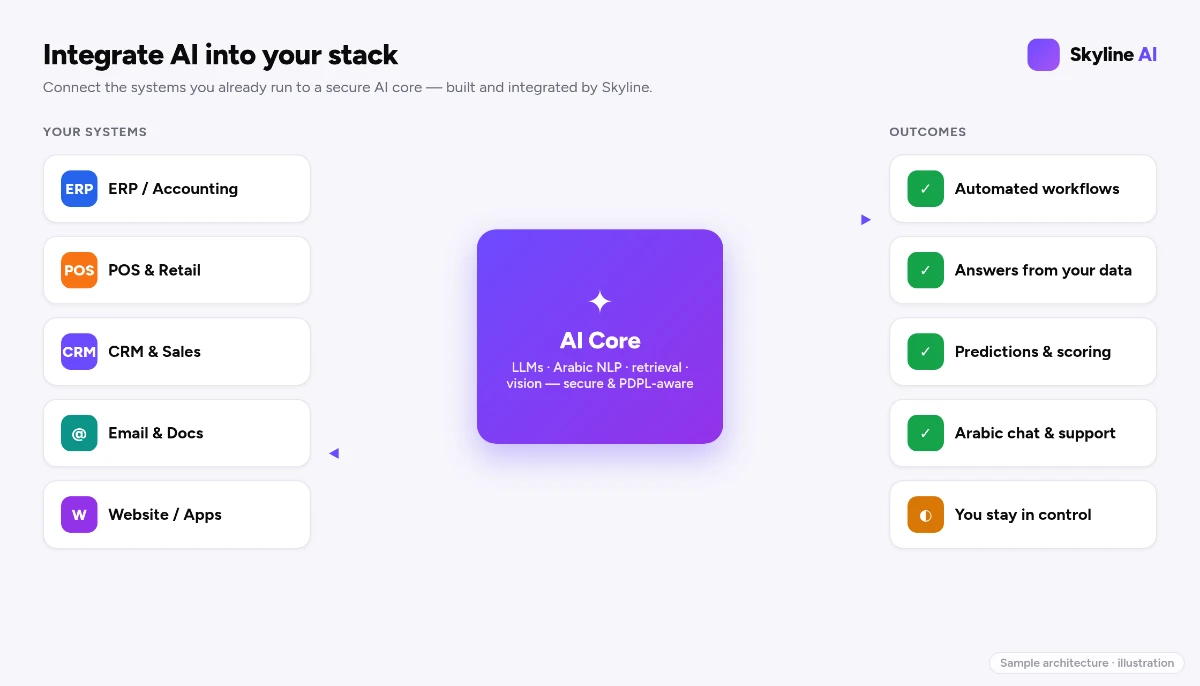
This is the same approach behind the pillar guide to integrating AI into your business software.
Frequently asked questions
Can the chatbot understand Saudi dialect?
Yes. We test on real Najdi, Hijazi and Khaleeji messages and on Arabic-English code-switching, not textbook Modern Standard Arabic alone.
Does it work on WhatsApp?
Yes. WhatsApp is usually the primary channel in the Kingdom, and the same assistant can also sit on your website, app and Instagram with one shared brain.
What happens when the bot does not know the answer?
It is built to recognise its limits and escalate gracefully to a human, handing over the full conversation rather than guessing.
Is the Arabic machine-translated?
No. Replies are written in a natural Saudi register, reviewed by people, not translated word-for-word from English.
How long does it take to launch?
A focused pilot on a single channel can be live in a matter of weeks. We measure deflection, satisfaction and conversion before expanding to more channels and languages.
Talk to a team that builds in Arabic
Skyline is Arabic-first by default — interface, content and support. If you want an assistant your customers will mistake for your best agent, book a free AI consultation and we will draft a conversation flow on the spot. Or explore the Skyline AI Integration service to see how Arabic NLP fits the wider stack.
Comments
0 total · 0 threads