
Most AI conversation is about text. But a huge share of business value is locked in images: the product on the line, the shelf in the store, the worker on the site, the invoice on the desk. Computer vision is the branch of AI that lets software see — and for Saudi businesses in manufacturing, retail, logistics and construction, it is often the fastest path to measurable savings.
What computer vision actually does
Strip away the marketing and vision systems do four things: they count (objects, people, vehicles), inspect (detect defects or anomalies), read (text, codes, documents) and watch (events, safety conditions). Almost every use case is a combination of these.
Use cases that pay off in the Kingdom
Quality inspection in manufacturing. A camera over the line flags defects a tired human eye misses — scratches, miscolours, missing components — at full line speed, 24/7. The result is fewer escapes, less rework, and consistent quality records. This is high-value in the Kingdom's growing industrial base.
Retail and footfall analytics. Vision counts visitors, measures dwell time by zone, detects queue length, and checks whether shelves are stocked and planograms followed — turning a camera you may already have into a merchandising sensor.
Workplace safety and PPE. On sites and in plants, vision can detect whether helmets, vests and safety gear are worn in designated zones and alert a supervisor — a practical aid for HSE teams, used to augment supervision, never to replace it.
Document and ID capture (OCR + AI). Vision reads invoices, delivery notes, national IDs and forms and turns them into structured data — feeding your finance or onboarding flow without manual typing. This pairs naturally with workflow automation and with AI inside ERP and POS systems.
Inventory and logistics. Counting stock, reading pallet labels, verifying loads, and spotting damage at the dock — vision speeds the slow, error-prone manual steps in the supply chain.
Asset and infrastructure inspection. Drones and fixed cameras inspect pipelines, facades, solar panels and equipment, with vision flagging anomalies for an engineer to review — relevant across the Kingdom's energy and infrastructure projects.
The honest caveats
Computer vision is powerful but not magic, and a responsible partner says so:
- Conditions matter. Lighting, camera angle and image quality make or break accuracy. A pilot in real conditions beats any demo.
- It needs examples. A defect detector must be shown enough examples of good and bad to learn the difference. Where data is scarce, expect a ramp.
- It is probabilistic. Vision gives a confidence score, not a certainty. Set thresholds, and route uncertain cases to a human — the same human-in-control discipline in our honest guide to generative AI.
- Privacy is real. Cameras that capture people involve personal data under PDPL. Where, how long, and why footage is stored all matter — see AI, PDPL and data residency.
How a vision project runs
- Pick one measurable outcome. "Catch label defects before shipping," not "use AI on cameras."
- Capture real images. From your actual environment, in real conditions.
- Build and test a narrow model. One defect type, one zone, one count.
- Pilot with a human check. Measure accuracy against ground truth; tune thresholds.
- Integrate. Wire alerts and data into the systems your team already uses, and keep humans reviewing edge cases.
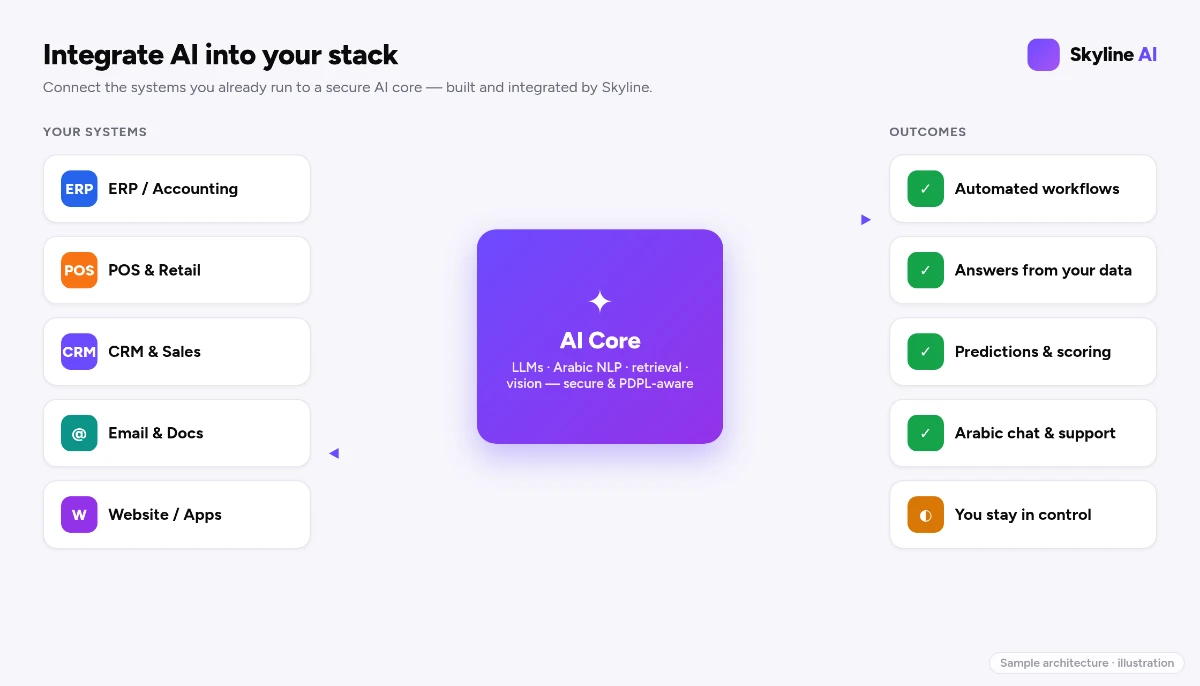
This mirrors the disciplined rollout in the pillar guide to integrating AI into your business software.
Frequently asked questions
Can I use my existing cameras?
Often, yes — it depends on placement, resolution and lighting. A short pilot in real conditions is the honest way to confirm before any investment.
Is computer vision 100% accurate?
No. It is probabilistic and returns a confidence score, not a certainty. The right design sets thresholds and routes uncertain cases to a person.
What about the privacy of people captured on camera?
Footage of individuals is personal data under PDPL. We design storage, retention and access with residency rules in mind.
How much training data do I need?
Enough examples of good and bad for the model to learn the difference. Where data is scarce, expect a ramp-up period rather than instant accuracy.
Can vision run on-site instead of in the cloud?
Often yes. Processing can run on-site for lower latency and tighter privacy, with only the results — not raw footage — leaving the location when that suits your data rules.
Which industries benefit most from computer vision?
Manufacturing, retail, logistics, construction and energy see the clearest returns — essentially anywhere people spend time inspecting, counting or reading things by eye. If part of your operation depends on visual checks, there is likely a use case worth piloting.
See whether your images hold value
If part of your operation runs on people looking at things — products, shelves, sites, paperwork — there is likely a vision use case with a real payback. Bring sample images or a described scenario to a free AI consultation and we will tell you honestly whether it is ready to build. Explore the Skyline AI Integration service to see vision alongside the rest of the stack.
Comments
0 total · 0 threads